
First Semester Survival Guide
Hello dear first-semester students,
Every beginning is tough – and that's especially true for starting university. New people, a huge campus, cryptic module handbooks, and the sudden feeling of being completely responsible for everything yourself. It's totally normal to feel a bit overwhelmed in the first few weeks!
But take a deep breath: we've already been through all of this. Because we know exactly how chaotic this first period can be, we've written this survival guide for you. We want to share our collective experiences and give you the most important things you need for a successful and relaxed university life. This way you can avoid typical first-semester stress and skip our own beginner mistakes.
We wish you a fantastic start to your first semester, lots of success with the upcoming challenges, and of course an unforgettable time!
Your Student Council
Contents:
- Everything you should have sorted before day one
- Everything you should do during the semester
- Further tips and sources of information
1. Before Your Studies
Once you've completed the application process and paid the semester fee, you're officially enrolled. Now it's time to get organised!
Application
- Make sure you've submitted all required documents and paid the semester fee during the application process. Only then will the university review your documents, enrol you, and send out the welcome letter.
- All info on enrolment & application on the official website offiziellen Website
- Even better: the application process is explained in detail with visual guides and flowcharts in the OVGU Wiki OVGU Wiki genau erklär
- Application portal: https://myovgu.ovgu.de

Dates
Now that you're officially enrolled, you need to identify the relevant dates for you:
- die wichtigsten Universitätsübergreifenden Termine findest du hier The most important university-wide dates can be found in the Academic Year Schedule. These include:
- Application period,
- Introduction days (organised by us, the student council – find the exact schedule on this page!) Den genauen Zeitplan findest du auf dieser Seite!),
- Start of lectures (to know where you need to be, you first need to put together your timetable – explained below)
- Exam registration period (about one month after the semester starts, you can register for exams in your chosen modules – don't miss it, or you won't be able to sit them!)
- Re-enrolment period (at the end of the semester you must re-enrol for the following semester, otherwise it will automatically be recorded as a leave of absence)
- Exam phases (a small peculiarity at our university: we write our exams during the semester break!)
Accounts & Access
- Several systems are relevant for your studies and participation in some lectures. Make sure you've set up all accounts. The most important ones:
- webmail.ovgu.de – Your university email. This also gives you access to many online libraries for academic literature and student offers
- myovgu.ovgu.de – Certificates, documents, semester fee, links to eLearning
- lsf.ovgu.de – Where you build your timetable
- In the UniNow app you can connect with your account and get notified when new grades are published
- elearning.ovgu.de – Where most lecture content is uploaded (with exceptions). Here you'll find your modules.
- bookstack.cs.ovgu.de – View your module catalogue, i.e. what you can actually choose
- ubfind.ovgu.de – The university library. With an account you can access all literature relevant to lectures (announced in the first lecture)
- In the "Welcome to OVGU" app you'll find a university-wide first-semester handbook, canteen menus, and info about campus events
Pre-Courses & Orientation Days
During the pre-course week we refresh topics from school and take the first steps in programming. During the following orientation days, we (the student council) help you build your timetable, show you around campus, and validate your UniCards together. Of course there's also plenty of fun and getting to know each other!
The Student ID Card Studierendenausweis
Your UniCard will be sent to you by post. It's your daily companion and serves as your student ID, library card, MVB semester ticket, and a payment card for the canteen and printers.
- Important: You must have the card printed at a validation station on campus (e.g. in Building 06 or 01).
- Take good care of it: if lost, your loaded credit is gone and a replacement card costs €10.30.
The First Boss Battle: Building Your Timetable
... good luck
2. During Your Studies
Your timetable is done, your modules are chosen, and you've been admitted to the restricted modules. Then student life really begins!
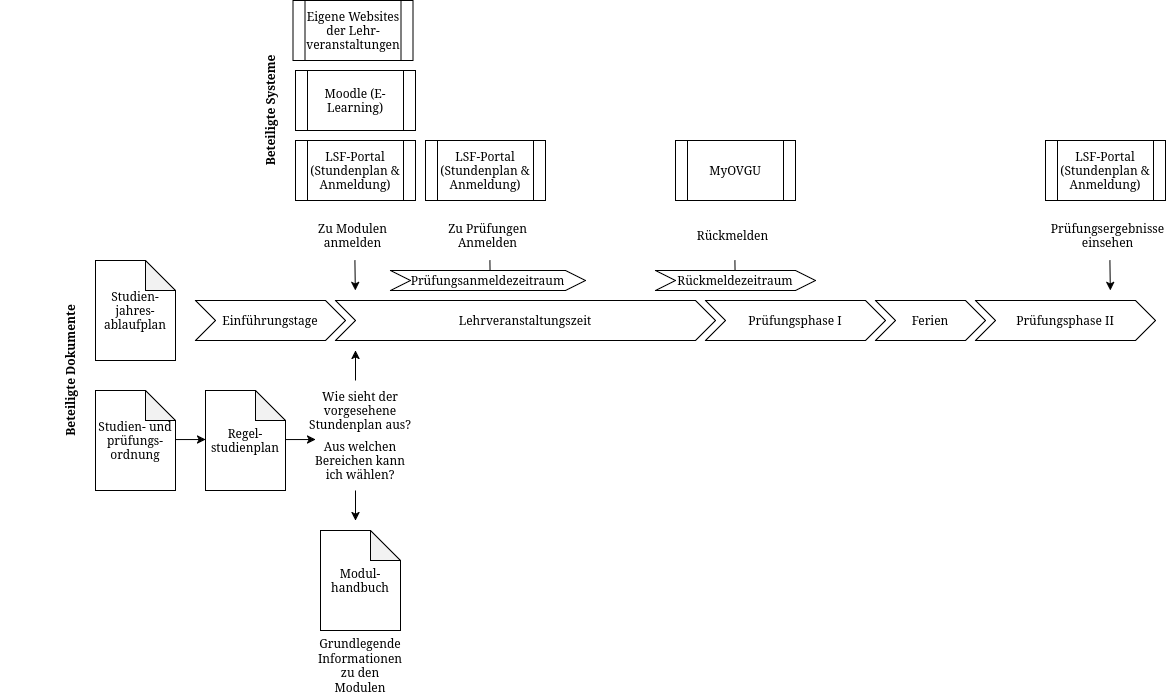
Studiendokumente Study Documents
It's important to know your rights and responsibilities as a student, or at least know who to ask:
- Among others, the General Study Regulations apply,
- the Study and Examination Regulations (by far the most important document!),
- later the Internship Regulations,
- for questions, the Student Council of the Faculty of Computer Science (FaRaFIN) is there for you as the representative body of the student body
Termine im Studium Key Dates During Your Studies
- Exam registration – approximately one month after the start of lectures (see Academic Year Schedule)
- Exam dates – the exam schedule is announced before the end of the exam registration period
- Re-enrolment – At the end of each semester you must re-enrol to continue your studies the following semester. The re-enrolment period for the summer semester runs from early January to early February; for the winter semester from early June to early July. Exact dates can be found on the OVGU website.
Digital Survival
- WiFi / Eduroam: Quick setup guide via the CAT tool: https://cat.eduroam.org/ or link to the IT Service Centrehttps://www.urz.ovgu.de/Dienste+und+Dienstleistungen/Allgemeine+IT_Dienste/WLAN/Anleitungen.html
- VPN: https://www.urz.ovgu.de/eduvpn.html and pit.ovgu.de. Some university resources are only accessible from within the university network. Set up a VPN connection to the university network so you can work from home too.
- Printing, Copying, Scanning: Link available via the URZ website https://www.urz.ovgu.de/Dienste+und+Dienstleistungen/Arbeitspl%C3%A4tze+und+Endger%C3%A4te/Drucken_+Kopieren+und+Scannen-p-5018.htmlD
- There are computer pools in G29 that you can use if you're starting university without your own laptop. Log in with your university account to use them.
Further Wisdom from Our Students
- Studies as a full-time job: Plan for around 40 hours per week for lectures, tutorials, and self-study.
- Marathon, not a sprint: Studying is a continuously improving process. Go at your own pace (30 credit points per semester is the guideline, not a requirement) and keep adapting your study methods and routines.
- Teamwork: Studying is not a solo sport. Network from day one and form study groups.
- Preparation starts on day one: Complete your exercise sheets conscientiously and keep up with the material throughout the semester.
- Active recall over highlighters: Passively highlighting slides doesn't help much. Use flashcards (e.g. Anki) or explain the material to others.
- Attendance pays off: Go to your lectures and tutorials. That's often where the exact concepts and problem types for exams are worked through.
- Learn with past exams: Get hold of old exam papers from your student council. They're the best tool for preparing for the real thing and understanding the format. The exam archive is here: https://farafin.de/dienste/klausuren/. Other faculties also have their own archives if you take modules elsewhere.
- Attend the exam review: Always go to the post-exam review. It's hugely important for understanding your own mistakes, and sometimes overlooked points can still be found.
- Meet deadlines: Do not miss the central exam registration periods (and no, the examination office does not negotiate).
- Be careful with AI: Don't blindly rely on text generators. Use them as a tool, but you have to do the actual thinking yourself.
- Create balance: With all that discipline, you still need breaks. Weekends are for switching off too.
Further Information
- An organigram of the faculty with relevant links: https://www.fin.ovgu.de/Fakult%C3%A4t/Organisationsstruktur.html
- Faculties at OVGU:
- Faculty of Mechanical Engineering (FMB)
- Faculty of Electrical Engineering and Information Technology (FEIT)
- Faculty of Process and Systems Engineering (FVST)
- Faculty of Computer Science (FIN)
- Faculty of Mathematics (FMA)
- Faculty of Natural Sciences (FNW)
- Faculty of Humanities (FHW)
- Faculty of Economics and Management (FWW)
- Medical Faculty (UMMD)
- Mentoring: Our faculty has a mentoring programme (https://farafin.de/studieninteressenten/mentoring/). Here you can get support and helpful tips to reach your academic goals.
- CP (Credit Points / ECTS): A measure of workload for a module (1 CP ≈ 30 hours).
- SWS (semester weekly hours): Recommended learning effort per module per week, as indicated in the module handbook.
- Graded vs. ungraded performance: The difference between a graded examination and a (usually) ungraded coursework requirement.
- Registration: Note on signing up for tutorial groups via LSF or Moodle, and on withdrawals/sick notes.
Community & Support
Studying is not a solo sport! Network from day one.
- FaRaFIN (G29-103): We represent you to the faculty. Drop by for past exam papers, advice, or just a cheap coffee.
- Mentoring: Our faculty has a mentoring programme with tips from students in higher semesters.
- There are more than 25 student initiatives at the university where you can get involved and meet new people, including:

- Acafin – The university's a cappella choir for anyone who loves to sing (pop to classical)
- Acagamics e.V. – The place for gamers and programmers to develop their own digital games at game jams
- AIESEC – Offers worldwide intercultural exchange and helps you train your soft skills on a global level
- Debating Club – Train your rhetorical skills and debate culture in weekly debates and seminars
- Enactus Magdeburg e.V. – Develop sustainable innovations and found non-profit start-ups to solve social problems
- FlaR – The community for road cycling enthusiasts, whether for relaxed group rides or competitive racing
- VWI Magdeburg University Group – Organises projects, workshops, and excursions to advance your career planning and soft skills (not just for industrial engineers)
- IKUS – Promotes intercultural exchange with international students, organises country evenings, and helps with general university questions
- Engineers Without Borders – Apply your knowledge to practical humanitarian projects, regardless of your field of study
- Love Foundation – A global network of artists and activists connecting people through worldwide cultural projects
- Queer Campus – The official contact point and representation for all LGBTQIA* and queer people on campus
- RIA (International Affairs Office) – Supports international students in settling into Magdeburg and strengthens intercultural campus life
- SIDUM e.V. – A student consulting firm where you gain real-world experience early through actual consulting projects and workshops
- Studenten bilden Schüler e.V. – Volunteer tutoring for children from low-income families or with a refugee background
- Student Stock Exchange Association – Teaches you the basics of stocks and financial markets through workshops and expert talks
- Students For Climate Justice – Actively campaigns for climate justice through actions, demonstrations, and educational events
- Student Riders – A group of horse-enthusiast students who compete in tournaments against other universities and love to celebrate together
- UMD Racing – For motorsport fans – design and build real racing cars as a team for the international Formula Student competition
Life in Magdeburg
- Registration office (Bürgerbüro): Anyone staying in Magdeburg for more than three months must register at the residents' registration office within the first two weeks of moving in. Bring your ID/passport and your landlord's confirmation of residence.
- Free money: The city supports students who register their primary residence in Magdeburg with a total of €160 ("Become a Magdeburger, study, and get paid").
- Mobility: Your semester ticket is valid on the MVB network (not Deutsche Bahn!). Download the "easy.GO" app for timetables. In the app you can log in with your university account to use your Deutschlandticket, which is included in the semester fee.
- Sport & Balance: The Sports Centre (SPOZ) offers various courses and its own gym (CampusFit). Registration is done online.
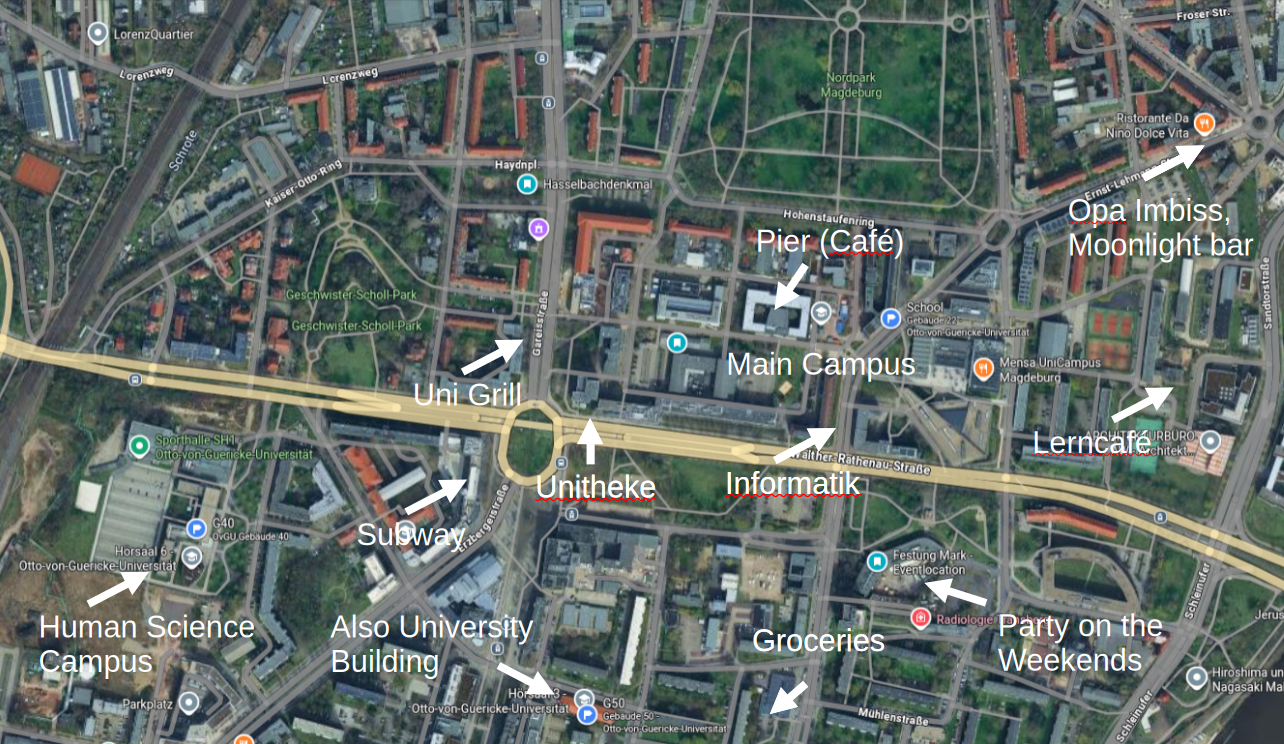
Kartendaten 2016 Google